

Hormonal Aggression in Male Rats
Does my rat have hormonal aggression?
Your boys got along great when they were babies, but all of a sudden they’re fighting.
Maybe they’re growing up, maybe an old rat passed away, or you introduced new rats, and a previously chill rat has become increasingly tense and combative, fighting other rats and maybe even biting people. Maybe they’re grooming everyone really intensely, scent marking like crazy, maybe they suddenly get really tense when you pat them, and have to be on top of your hand instead of below it (if so, you may be in danger of being bitten!), or maybe they have a lot of orange grease on their back these days that you may have thought was mites, and smells oddly of toasted corn chips.
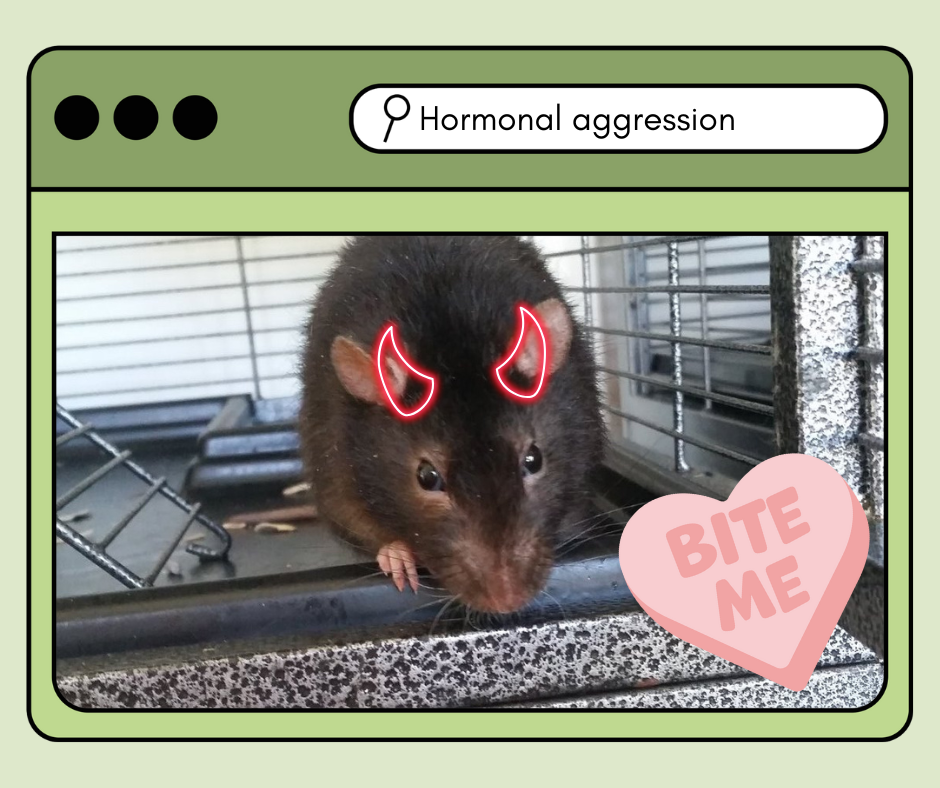
If this sounds like your rats, you might be witnessing the effects of hormonal aggression, or ‘HA’ for short. It’s one of the most common reasons for distressed owners to reach out to us for advice or rehoming. It’s a heartbreaking, sometimes avoidable situation that causes so much stress for owners, puts rats in bad welfare situations, and can cause a lot of damage.
Case study: Jax
Jax and his two brothers were bought from a reputable, club registered breeder and had no problems when they were young, but when they reached maturity all three developed hormonal aggression. Their owner loved them all very much, but after she and her young son were attacked multiple times, they developed a fear of rats and couldn’t care for them safely. With no assistance from the breeder, she asked me if I’d take them instead, back when the rescue was first starting out. Cropped out of this photo is my finger, which was dripping blood at the time. Jax was never adopted out for obvious reasons, but with the right care he and his brothers lived a long happy life in my home without being a danger to care for. The owner and her son visited regularly to check in on the boys, and slowly get used to handling my other rats. Eventually they both overcame their fear and could be around rats again, though they had been put off having them as pets.
What is it?
In short, hormones are a normal and important part of every mammal and perform many roles in physical and mental health. Domesticated rats have been selectively bred to manage them so they can live peacefully in a pet environment without ill effect. When hormones are too low males lose interest in breeding, and when they’re high, they breed more. This means populations left uncontrolled will naturally trend towards high hormones. When they’re too high, they cause aggression and excessive dominance. They can bully, control or injure other rats and even humans, and they themselves may develop mental health issues from the stress of living in a constant state of needing to fight.
What causes it?
Whether a rat has high or low hormones is largely based on genetics, which means it is a result of breeding, and that siblings of aggressive rats are also at risk of it becoming a problem. However, it isn’t always immediately obvious that a rat has HA. The onset is generally triggered by hormonal and social factors like a shift in the ‘pecking order’ when rats grow to a mature size and start to establish their place socially, or when there is a sudden shift like rehoming, a new rat arriving, or the loss of a cagemate. It can also be triggered by exposure to pheromones from rats that are ‘strangers’, especially the opposite sex. Physical contact isn’t required, as the pheromones are airborne. For example, we used to regularly invite breeders to the rescue with their rats so they could use us as a screening tool, in the effort to reduce the amount of aggressive rats being sold. Rats who had never showed any signs at home would suddenly be puffed up and attacking their own siblings, due to the strong pheromones of so many ‘stranger’ rats in the room. It also meant that any rats who were surrendered to the rescue identified themselves as needing treatment very quickly, a neat safeguard to ensure we weren’t being part of the problem.
Is it treatable?
Yes, but it won’t resolve by itself once it’s been triggered, even if you remove the trigger. Fortunately, desexing has a very high success rate in treating male hormonal aggression, and can be done with either a physical neuter or a hormonal implant such as Suprelorin. It might take a month for them to settle down, sometimes a little longer with the implant. There is some evidence that the implant is better than a neuter, as it controls the hormones without reducing them so much that it causes extremes in the other direction, which can sometimes result in rats becoming anxious, depressed or excessively submissive. It is best to address it as early as possible. The longer it goes on, the harder it is to unlearn all the learned behaviours and traumas and secondary mental health issues developed while living in that state. Acting swiftly minimises the welfare impact and risk of injury, mental health decline and death, for all rats involved.
You may also need to temporarily separate rats if they are a danger to others. Living in isolation is not a humane solution long term for most rats and is never advisable, however a temporary recovery cage nearby may be the lesser of two evils to prevent physical or psychological harm if the aggression is extreme.
If it’s a genetic disorder, why hasn’t it been bred out?
The risk of a rat developing hormonal aggression, the age of onset and severity of the behavior are all strongly genetic traits, which means the only people who can do anything to address the issue are the breeders.
Breeders can quite readily select for more or less hormones over generations depending on their priorities and purpose. Some breeders select for high hormones for high growth rates and large size, maximizing profit in feeder breeding. Others select for lower hormones, for happy, healthy pets. Unfortunately the level of involvement, diligence and record keeping required to breed for health and temperament makes it unprofitable and time consuming, so health and temperament breeders can be difficult to find, and aggression continues to be a widespread problem.
What’s the best way to minimise the risk of buying aggressive rats?
Detecting the subtle cues of a predisposition to later develop HA in a baby rat in a sale environment is extremely hard for the average owner. Screening the source is often easier than screening the rats. If you’re a new owner and you have your heart set on babies or taking steps to consider genetic health and temperament, you’re likely going through a breeder or a pet store. These might be the right choice for you, our hope is that all owners have the knowledge to make informed choices and find something that is in line with their own values and needs.
It is strongly recommended not to go to a pet store. A breeder with health and temperament in mind needs to get as much feedback as possible over the lifespan of the rat, so they can select against issues that pop up later in life such as hormonal aggression and tumours. Ethical breeders also take accountability for their animals, taking them back if needed and providing lifelong advice and support. They genuinely care about where the animals go, screening buyers to make sure the rats will be cared for well. Selling to pet stores is quick money, and cuts ties, information and responsibility for the animals which is why ethical breeders won’t do it, and why many rat clubs have rules against their breeders doing so, which severely limits the quality of the breeders stores can source animals from.
If you’re going through a breeder, know that some are incredibly beneficial to rats, others are terribly harmful. Terms like ‘ethical breeder’ and ‘health and temperament rattery’ are subjective and get used a lot as marketing terms, but don’t provide any information about welfare, ethics, quality or competence.
It can be hard to tell the difference as a new owner, but the best you can do is ask lots of questions. Make sure you can meet the immediate family of your rats including adults living comfortably with other adults. Make sure you’re comfortable with how they’re treated, and with their practices. Avoid those who pressure you to make a purchase quickly, or without being able to handle the rats. Try to determine what the breeder’s purpose is, and if their practices match their stated values. You might want to ask them how they track health and temperament information, and ask them what they’re currently working on in the line, and if there are any known issues or aspects they’re not happy with.
Remember that rats are a work in progress everywhere. Don’t expect perfection, but don’t fall for those who claim to have it either. You always run the risk of having issues pop up, all you can do is minimise the risk, and make informed decisions.
If you’re worried about aggression and don’t want to take a chance on babies, mature rats from a rescue, a breeder, or a community rehome might be a good fit. Mature rats can be a great choice for new owners, and in the cases where common issues have surfaced, it might suit some people better to go in knowing what they are and how to manage them (or that they’ve already been treated and resolved), rather than trying to learn on the fly.
My rats are aggressive, does that mean the source was bad?
Not by default. Hormonal aggression cropping up now and again even in a good line is actually pretty common in Australia, and no reason to think poorly of wherever you got them from so long as they’re doing the right things about it. The important thing is that no matter where you get your rats, be it a breeder, store, or a rescue or otherwise, you need to tell them so they can respond appropriately, like being transparent with other owners and offering support or to take rats back, or stop selling and work on the line until it’s temperamentally stable again.
The source may genuinely not know hormones are running high. In some countries with long established, collaborative communities, breeders have achieved health and temperament over decades that is consistently improved over what is found in random backyard situations and pet stores. Mixing rats from unknown sources into a well bred line is seen as taboo, because that would mean undoing years of progress and introducing potential issues. Here, a breeder with no health or temperament progress to lose may still be frequently mixing in new rats with unproven history in search of promising genetics, and genuinely have no idea what issues are present yet.
What if someone is consistently doing the wrong thing?
It is not acceptable from an ethical, welfare, liability or legislative perspective to knowingly breed and sell dangerous or sick animals.
That might seem obvious to most of us, however, there will always be those who strongly and openly disagree with that statement. We don’t all need to have the same values or goals, but the pet community does deserve to be able to make informed choices about welfare and safety. We get a lot of emails seeking support after buying rats with genetic issues and many report receiving backlash or no support after contacting the source.
Untreated hormonal aggression can get rats injured, traumatised or killed, and forces rats into isolation, which is a big welfare problem. That is serious enough, but HA can also cause aggression towards humans in the form of dominance and territoriality, reactive biting, or redirected aggression if humans intervene during rat-on-rat hostility. This is especially true if it goes untreated, of if the rat also has a predisposition to biting as a defense mechanism rather than avoidance, or a low threshold for reactivity, which are also heritable traits.
Rat bites are serious. They can cause permanent injury and disability, people have even died. Personally, a rat bite once put me in hospital for a week, I nearly lost my hand, and developed a heart condition from the infection. If you know someone who is knowingly selling aggressive rats and putting people at risk, there may be steps you can take to keep our community safer, or to seek support if it’s happened to you.
Even if you suspect the seller is unlikely to respond positively or productively, you should still always tell them, and keep a record of doing so. Australia’s animal welfare laws prohibit the sale of animals that pose a risk to public safety, and while rat-specific laws are rare, there are increasing state based legislative protections for animals such as the Code of Practice for the Breeding of Animals with Heritable Defects that Cause Disease which clearly state that; “It is a cruelty offence to permit an animal to suffer from a heritable disease.” and that “animals with disease caused by a heritable defect must not be disposed of to another person without advice of the animal's heritable defect status.” There are also Australian Consumer Laws for the purchase of animals which may protect you if you’re sold sickly or dangerous rats. Additionally, those who knowingly sell aggressive animals (including those with a genetic predisposition) or fail to take appropriate measures or disclose known issues are leaving themselves open to liability for negligence, in the event that someone or their animals are harmed. RRH always tries to inform any known source including breeders, pet stores and rescues, when aggressive animals from them are identified in our care, unless they have asked us not to, or have been hostile or threatening. We keep records which we may be able to disclose for specific reasons such as welfare, safety or legal matters.
In summary:
Hormonal aggression most often presents as male suddenly behaving aggressively, especially after becoming physically mature, being exposed to strange rats or females, or undergoing a shift in social dynamic.
Usually the behaviour is dominance based, and may involve fighting, picking on or controlling the other rats. They may start to excessively produce orange buck grease on the skin of the back and flanks, or increase hormonal behaviours like excessive marking and territorial behaviour.
If you are dealing with a hormonally aggressive rat, be mindful of a potential increased bite risk. Separate temporarily if any other rats are in danger physically or otherwise, and talk to your vet ASAP about surgical or hormonal neutering options. It may take up to a month after treatment to see improvements.
If you know who bred and/or sold the rat, it’s important that you tell them so they can address the issue in other related rats, and to prevent further aggressive rats being sold.
Over the next few weeks, we will be compiling a series of articles that expand on this article, with more detailed, practical advice about how to identify and safely deal with hormonal aggression, why it occurs, how it impacts welfare, and how to avoid encountering it. Feel free to reach out to us about anything in this article, or to suggest a topic. You are also welcome to join in and contribute to the educational resources, it takes a community to make a positive difference.
Always nice squeaking to you.
Grove
-
About the author: Grover (formerly Rachie) Greenfield has served the pet rat community via RRH since it’s founding in 2017, and is a passionate educator and advocate about rat care and welfare. They have a BSc in biology with a background in genetic engineering, and a passion for ethics, serving as an animal welfare expert on multiple Animal Ethics Committees, ensuring ethical and legislative compliance for research animals.